Yes, handwashing is a real requirement on most Saint Paul job sites, not an extra. OSHA 1926.51(a)(1) calls for an adequate supply of potable water at every workplace, and 29 CFR 1910.141(d)(2) requires soap and towels or a hand-drying device wherever washing facilities go in. Saint Paul Porta Pros sets up stations that meet both.
The rule people misquote most is 1926.51(f)(1). It only applies where workers are applying paints, coatings, herbicides or insecticides, or handling other harmful contaminants, not to a general construction crew swinging hammers. If your Saint Paul crew is spraying finish or mixing chemical treatments, that clause kicks in and you need washing facilities on site, full stop. For everyone else, the baseline is simpler: 1926.51(a)(1) covers potable water, and 1926.51(c) sets your toilet counts by crew size. Farm operations follow a different standard. Under OSHA 1928.110, hand-labor employees need potable water, toilets and handwashing within a quarter mile walk, at one facility per 20 workers. If you're staffing a harvest crew outside the city, check our farm and agricultural restrooms page before you assume the construction rule applies. Pair any toilet order with a sink; see our handwashing station rental options for what ships with each unit.
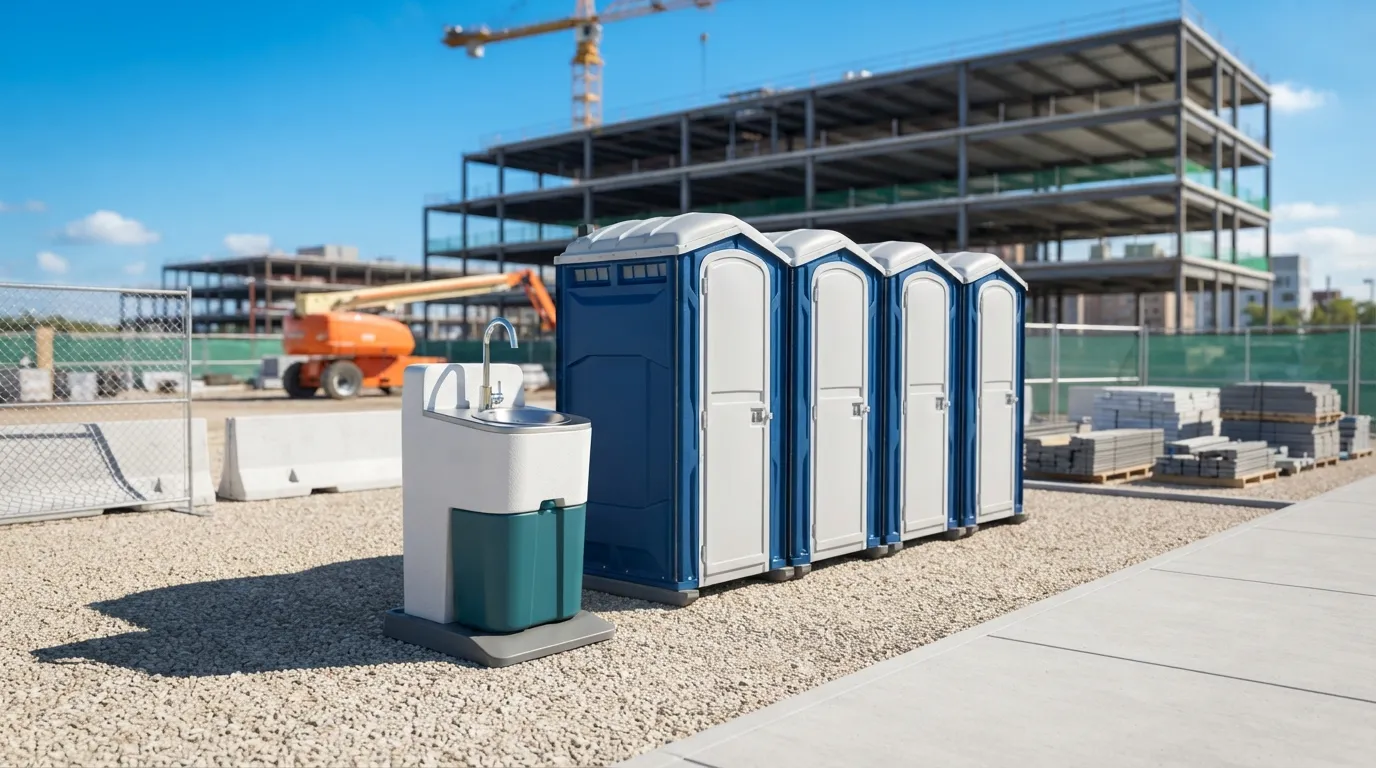
Match your stations to your toilet count, not to a flat number. OSHA 1926.51(c) sets one toilet facility for 20 workers or fewer, then one toilet seat and one urinal per 40 workers as crews grow past 20, dropping to one per 50 once you hit 200 workers or more. A single handwashing station rental or portable sink rental placed next to each restroom cluster usually covers that ratio without extra math. Indoor workplaces follow a separate general industry table under 1910.141(c)(1)(i), so a Saint Paul warehouse crew isn't measured the same way as a road crew on a downtown block. If you're not sure which count applies to your job, our OSHA portable toilet requirements guide breaks down both tables side by side, and how many porta potties do I need walks through the arithmetic for mixed crews.
No. Hand sanitizer does not satisfy 29 CFR 1910.141(d)(2), which specifically calls for soap and towels or a hand-drying device at washing facilities. A hand sanitizer station rental is a fine supplement near an entrance or a break area, but it can't stand in for the sink itself on an inspected job. Saint Paul general contractors who get this wrong usually find out during a walkthrough, which is a bad time to discover it. The fix is easy: rent both. Keep a sink at the restroom cluster and sanitizer at high-traffic touchpoints like tool cribs or gate entries. If your project also involves painting, coating, or pesticide work, that's the trigger for 1926.51(f)(1), and a sink placed right at the mixing or spray area does double duty for both standards at once.
Put them next to the toilets, not across the lot. ANSI/PSAI Z4.3 sets a baseline service interval of once weekly for up to 10 users over a 40 hour week, and that servicing schedule is a lot easier to hit when sinks and toilets sit in the same cluster instead of scattered across a Saint Paul site. Ground conditions matter too. Stable, firm, slip-resistant footing under an accessible unit follows ADA Standards 302.1, and if you're placing an ADA unit anywhere near a station, ADA Standards 403.5.1 calls for a 36 inch clear route to reach it. Our porta potty placement guide covers ground prep, and ADA restroom requirements covers the accessible unit side in more detail. If the placement spot sits in a public right of way, that needs confirming directly with the city; we don't guess at permit rules we haven't verified.
Saint Paul crews working near West St. Paul, 4.3 miles south, or Maplewood, 8.8 miles northeast, often run one delivery route for toilets, sinks and fencing together. Our temporary fence rental page and construction site services page cover how we bundle those drops.
| item | duration | typical |
|---|---|---|
| standard unit | day | $150 |
| standard unit | week | $200 |
| standard unit | month | $200 |
| delivery fee | day | $150 |
Handwashing stations usually ride along with a toilet order rather than pricing separately; ask about bundled delivery when you request a quote.
ANSI/PSAI Z4.3 sets a baseline of once per week for up to 10 users across a 40 hour work week. Busier Saint Paul sites, or ones running multiple shifts, need a tighter schedule. Ask about a servicing plan when you book your portable restroom rental.
Yes. A standalone portable sink rental works for food vendors, farmers markets, or any Saint Paul event that already has restrooms but needs a wash station. Delivery fees still apply separately from the unit rate.
Not necessarily its own, but it needs to be reachable. ADA Standards 308.2.1 sets a 48 inch maximum forward reach, and operable parts must meet ADA Standards 309.4, no tight grasping and 5 pounds max force. See our ADA accessible porta potty page.
A handwashing station has running water, soap and towels, meeting 29 CFR 1910.141(d)(2). A hand sanitizer station rental is gel or foam only, no water. Use sanitizer as a supplement, not a substitute.
Most do, especially food vendors. Check our event restroom rental and festival restroom rental pages for what typically pairs with a sink order at outdoor gatherings.
Yes. Saint Paul Porta Pros delivers handwashing station requirements across Saint Paul and the surrounding metro, with same-day and next-day drop-off available on most orders.
Pricing depends on the unit and how long you need it. See our cost breakdown and request a free quote for an exact figure.
Standard rentals include scheduled service — a pump-out, a clean, a restock and fresh deodorizer. Busy or hot-weather sites can be serviced more often.
Call now or request a free quote — clean units, on-time delivery, transparent pricing.